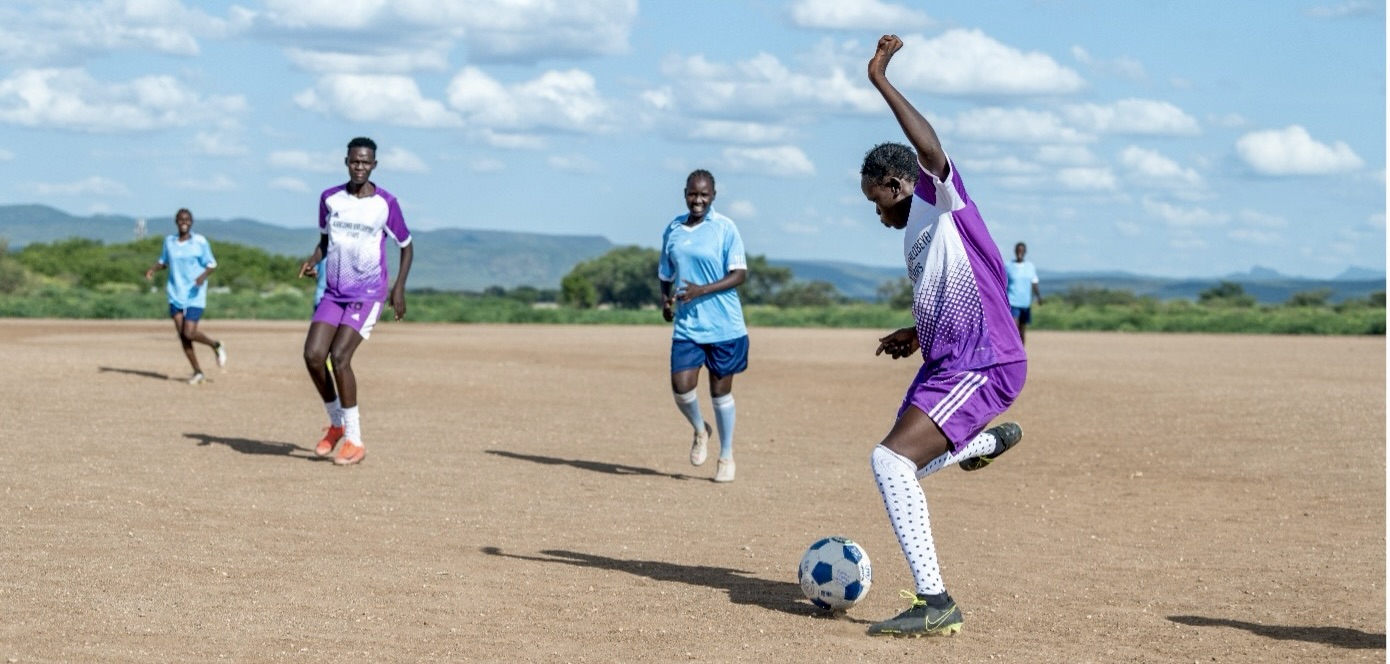
Cover photo: Football match featuring teams from Kakuma refugee camp and Kalobeyei settlement. Photo: LWF/Albin Hillert, Flickr
by Sudha Rawat and Rose Jaji
The sharing of solo women researchers’ experiences is making inroads into social research and challenging male-biased methodologies. In this blog post, we draw from our respective experiences while conducting ethnographic research with refugees (Sudha in India and Rose in Kenya). We observe that solo women researchers’ experience the field in gendered ways that have contradictory manifestations. On the one hand, they are not always taken seriously as researchers and, in some instances, experience sexual harassment or worse. On the other hand, their self-identification as researchers is sometimes regarded as a pretext for nefarious activities, which can endanger their lives.
Based on these challenges, we highlight three main points. First, women researchers’ self-positioning in the field does not necessarily influence how their interlocutors position and relate with them. Second, gender has fluid and sometimes contradictory meanings that women researchers constantly navigate. Third, gender is mediated by other social categories that alternately create mutual identification and difference between women researchers and interlocutors of various genders.
The woman researcher as the embodiment of danger
When women introduce themselves as researchers in the field, it does not necessarily follow that their interlocutors take this gender-neutral self-identification as primary. Interlocutors can push the researcher label to the background and bring other labels to the fore that reflect their own ideas about women in general and their impressions of the specific woman researcher in their space. These ideas and impressions play an important role in shaping the research interface. The factors that influence the research encounter are not limited to gender but extend to its intersection with age, marital status, economic status, place of origin, race, ethnicity, and even local language proficiency.
The factors that influence the research encounter are not limited to gender but extend to its intersection with age, marital status, economic status, place of origin, race, ethnicity, and even local language proficiency.
While conducting research with refugees in Nairobi, Kenya, Rose had to navigate instances of mistaken nationality and ethnicity. In one instance, she was mistaken for a spy for a country whose citizens were among the refugees. Word spread around in this community warning its members to be wary of her. They kept their social distance until they became satisfied and concluded through their own probing questions that she was neither a citizen of nor an intelligence operative for their country. As she interacted with these refugees, she became the researched, in contrast to standard practice in qualitative research interviews. In another instance, her interlocutors mistook her for a member of a Kenyan ethnic group stereotypically cast as thieves and treated her with suspicion. In both instances, her gender and age were decoded as the embodiment of criminal tendencies and danger.
During her research with Sri Lankan Tamil refugees in Tamil Nadu, India, Sudha encountered a deeply distressing situation in her interaction with an elected representative of the local administration. He accused her of terrorism and labelled her as a suicide bomber in front of the research participants. He further accused her of receiving a large sum of money to destabilise (bomb) Tamil Nadu because she was affiliated with an Indian university known for its students’ long-standing association with activism, left-leaning politics, and political controversy. Instead of apologising for his accusations, the representative dismissed them as a joke. Sudha’s research topic, involving mapping various manifestations of sexual violence against women during conflict, exposed her to accusations, suspicion, and antagonism. Her institutional affiliation, in combination with her gendered identity, became a source of hostility and suspicion rather than legitimacy.

Solo women researchers can also become victims of sexual harassment, abuse, rape, and intimidation during ethnographic research, for example, at the hands of gatekeepers, research participants, and other interlocutors. Sexual harassment during fieldwork remains widespread but systemically silenced. For instance, one man who had witnessed the local government representative’s treatment of Sudha mentioned above suggested that her interlocutors take her to a film studio, implying that she belonged in adult (pornographic) films. This incident affected her research as some participants questioned the legitimacy of her work and withdrew from the research.
Cultural misunderstandings can also expose solo women researchers to judgement. One refugee woman labelled Sudha as loose because she arrived for the interview with a male interlocutor with whom she chatted and laughed. To her, Sudha’s level of education and attire made her more attractive and interesting to men. Consequently, her interpersonal interactions became the object of the judging local gaze, thus making her vulnerable to stigmatization for non-conformityto local norms. Similarly, refugees in Nairobi frequently reminded Rose that she was not poor like them and could leave Kenya whenever she wished. The intersection of perceived economic status with gender, age, and education created complex experiences and fluid identities that required constant negotiation. Ethnographic research often places women researchers in dependent positions where they sometimes tolerate behaviour they otherwise would not.
Ethnographic research often places women researchers in dependent positions where they sometimes tolerate behaviour they otherwise would not.
The perception of Sudha as a terrorist/suicide bomber and Rose as a spy and thief shows the challenges of research with vulnerable populations and that research on topics such as war, displacement, and sexual violence is not politically neutral. It carries the potential to expose uncomfortable realities such as state failure, abuse by the military during conflict, persistent insecurity among refugees, and deep-rooted social biases. Consequently, women researchers working on these issues may frequently experience resistance, censorship, intimidation, and contestation of their work by both participants and gatekeepers. Our academic curiosity was viewed through the lens of security and suspicion, which exposed us to gendered scrutiny and surveillance. For both of us, trust was only established through a process of questioning which reversed roles in the research interface and transformed it into a mutual exchange of self-identifying information beyond the formalities of establishing rapport. Our interlocutors did not automatically tag the researcher label onto us when we introduced ourselves as such. Rather, it was only after passing the tests they set for us in our respective research sites that we became researchers to them.
Femininity as the object of care and protection
Women researchers can conversely build positive and even life-long relationships with their interlocutors especially in the age of digital communication platforms. Despite their own security concerns, the refugees, regardless of gender, took Rose as an object of care who needed their protection as people who had lived in Nairobi for much longer than she had. They also made her welcome in their communities as a fellow African whom they addressed in familial terms. Rose was often mistaken for a Kenyan and her presumed resemblance to an ethnic group more liked than the one she was associated with above made her familiar and benign. She was treated with affability. When thieves broke into Rose’s accommodation while she was out conducting interviews and stole her research gadgets, the refugees commiserated with her and offered to redo the interviews. Fortunately, she had backed up the audios and transcripts on another gadget, which she kept separate from the rest. A young refugee woman confronted the property owner and helped Rose move to her own neighbourhood so that she could watch over her. This woman and Rose remain close friends.

Despite Sudha’s outsider identity as a North Indian who spoke Hindi in South India, many refugee women received her with curiosity and hospitality, which brought her closer to the community. They invited her to their homes for lunch and family celebrations such as birthdays and weddings. Local researchers do not often receive such invitations because they are ostensibly familiar with the participants’ caste, family background, and political affiliations, which makes the refugees fret about gossip and judgement. Research participants and other community members also protected Sudha. When a drunk refugee man shoved and physically roughed her up because she was a “foreigner”, one research participant, an elderly woman who had seen this happening, immediately intervened by confronting the man and supporting Sudha. She took this matter to the camp administrator and once the matter was resolved, she, along with other women from the camp, accompanied Sudha to the bus station to ensure that she was safe.
From our experiences, we emphasise personal security and encourage women researchers to leave the field when they face challenges that put them at risk.
Care and support also involve advice on how the woman researcher can conduct her research safely. Many times, refugee women suggested to Sudha to present herself as a traditional woman by wearing jewellery and avoiding jeans, which would physically expose her to unwanted attention; the traditional woman image would ward off the male gaze. The absence of jewellery from a married or unmarried woman’s body was also associated with poverty and it rendered women more vulnerable to unwanted male attention. These women were not sharing superficial fashion advice but their personal embodied experiences, teaching Sudha how to navigate social realities and cultural norms in intrapersonal, interpersonal, and structural encounters in their space.
Rapport as constant personalized negotiation
Power dynamics during fieldwork do not automatically mean that the woman researcher holds more authority. In both heterosocial and homosocial interactions, we fluctuated between dangerous and suspicious outsiders and vulnerable young women who needed protection and support. We had shifting and multiple gendered positionalities. Our experiences show that the research encounter is subject to constant negotiation beyond the initial rapport and entails unanticipated realities that are more about personalised encounters and adaptation than training and disembodied neutral observation. From our experiences, we emphasise personal security and encourage women researchers to leave the field when they face challenges that put them at risk.
About the authors
Sudha Rawat is a feminist political geographer based in New Delhi, India. Her research explores gender, conflict, forced migration, and refugee experiences, with a particular focus on sexual violence and displacement in conflict zones. She is an Emerging Global South Programme Fellow at the German Association for Peace and Conflict Studies (AFK), Germany.
Rose Jaji is a senior researcher at German Institute of Development and Sustainability (IDOS). Her research focuses on migration and displacement and addresses migration historicity, governance, trajectories, categories, and gender. She is the author of Deviant Destinations: Zimbabwe and North to South Migration (2019, Lexington Books) and Non-Migration amidst Zimbabwe’s Economic Meltdown (2023, Lexington Books).
Leave a Reply